You want to learn Dutch by yourself.
Maybe taking a course does not fit your schedule. Maybe you prefer studying at your own pace. Maybe you already use an app or textbook but still feel unsure about what you should actually learn next.
There is no shortage of Dutch-learning material online.
The difficult part is knowing:
- What do I need to know for A1?
- What should I study first?
- Which vocabulary and grammar matter at this level?
- How do I practise listening and speaking on my own?
- How do I know if I am actually making progress?
That is exactly why we created the Dutch A1 Roadmap.
It gives you a clear path through the practical topics and skills you need to work toward A1, with links to lessons, exercises and resources on Self Study Dutch.
Can You Reach Dutch A1 on Your Own?
Yes. A1 is a realistic level to work toward independently.
You do not need perfect grammar, thousands of words or the ability to understand normal-speed Dutch conversations.
At A1, you are learning to manage very simple, familiar situations.
For example, you should gradually become able to:
- introduce yourself
- spell your name
- give basic personal information
- understand numbers, dates and times
- talk simply about your family and home
- describe your daily routine
- buy something in a shop
- ask simple questions
- understand short everyday messages
- write a few simple sentences
The challenge is making sure that you practise these things together instead of collecting random vocabulary and grammar rules.
The Problem Is Usually Not Finding Resources
If you decide to learn Dutch independently, you can find almost everything somewhere.
There are:
- Dutch textbooks
- language-learning apps
- YouTube lessons
- vocabulary lists
- podcasts
- grammar websites
- flashcards
- online exercises
You could easily spend more time looking for Dutch-learning resources than actually studying Dutch.
And after finding all those resources, you are still left with the same question:
What should I do next?
That is where a roadmap helps.
Instead of treating Dutch as hundreds of separate lessons, you can work toward things you actually need to be able to do.
Learn Dutch Through Real-Life Goals
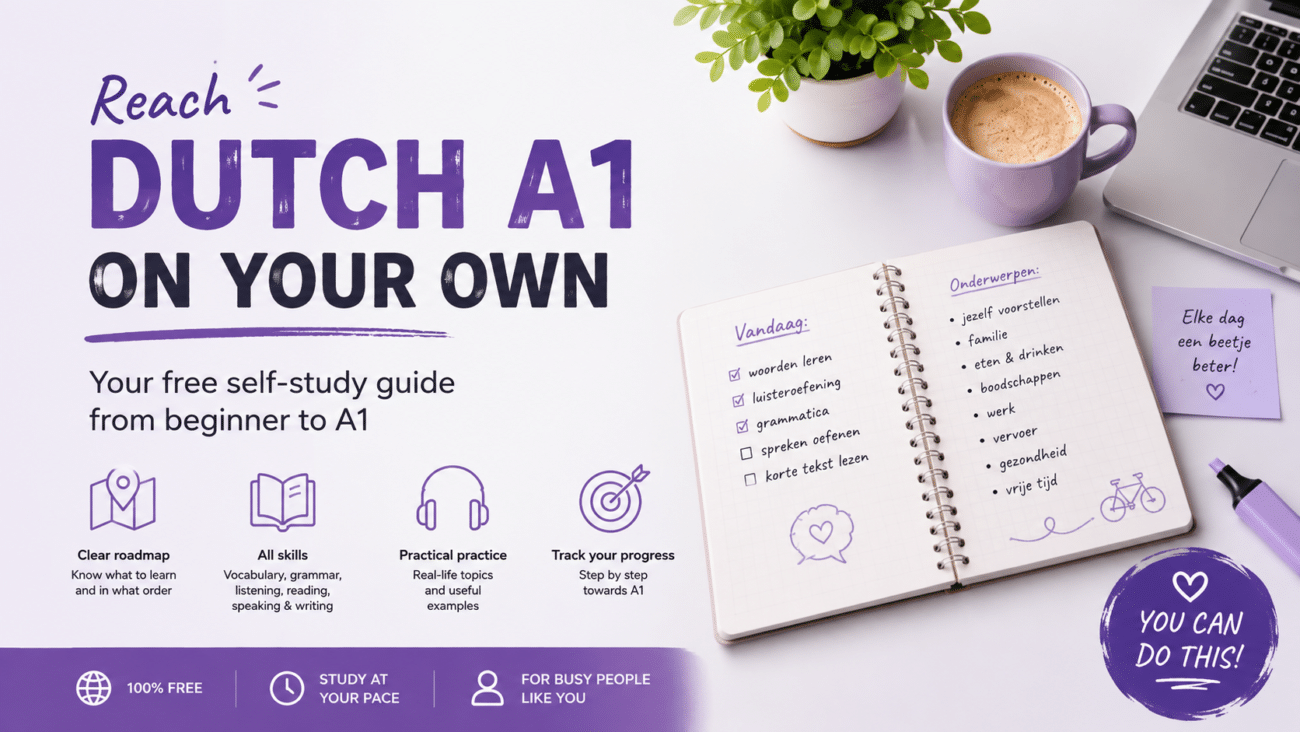
The Self Study Dutch A1 Roadmap is organised around practical situations rather than a long list of isolated grammar topics.
You will work through areas such as:
Introducing yourself
Learn the alphabet, spell your name and email address, say where you come from and answer basic personal questions.
Numbers, dates and time
Understand phone numbers, prices, dates, times and simple appointments.
Home and where you live
Talk about your address, rooms, everyday objects and your neighbourhood.
Family and people
Talk simply about your family and describe the people around you.
Daily life
Describe what you do during a normal day.
Food and shopping
Understand prices and quantities and manage simple interactions in shops.
Getting around
Ask where something is and understand basic directions and transport information.
Work and study
Talk about your job, workplace, school or studies.
Health and appointments
Describe a simple problem and understand basic appointment language.
Free time and plans
Talk about hobbies, likes and dislikes, invitations and simple plans.
And finally, you can check whether you can actually use what you have learned.
How to Study Dutch on Your Own
Use the Roadmap Your Way
There is no perfect method. Use textbooks, videos, flashcards or other resources alongside the roadmap. Skip what you already know and spend more time where you need it.
Mix Your Skills
Don't only memorise vocabulary. Combine words, listening, reading, speaking and practice around the same everyday topic.
Learn Grammar for a Reason
Grammar helps you communicate. Learn zijn to introduce yourself, question words to ask for information and willen to say what you want.
Practise Before You Need It
Speak aloud, answer simple questions and practise using your own information. Measure progress by what you can actually do in Dutch, not by how many lessons you finish.
You Don’t Need to Learn Everything Today
You only need to know what to work on next. Use the free A1 roadmap to follow the path at your own pace, or jump straight into the first practical step and start using Dutch.
