
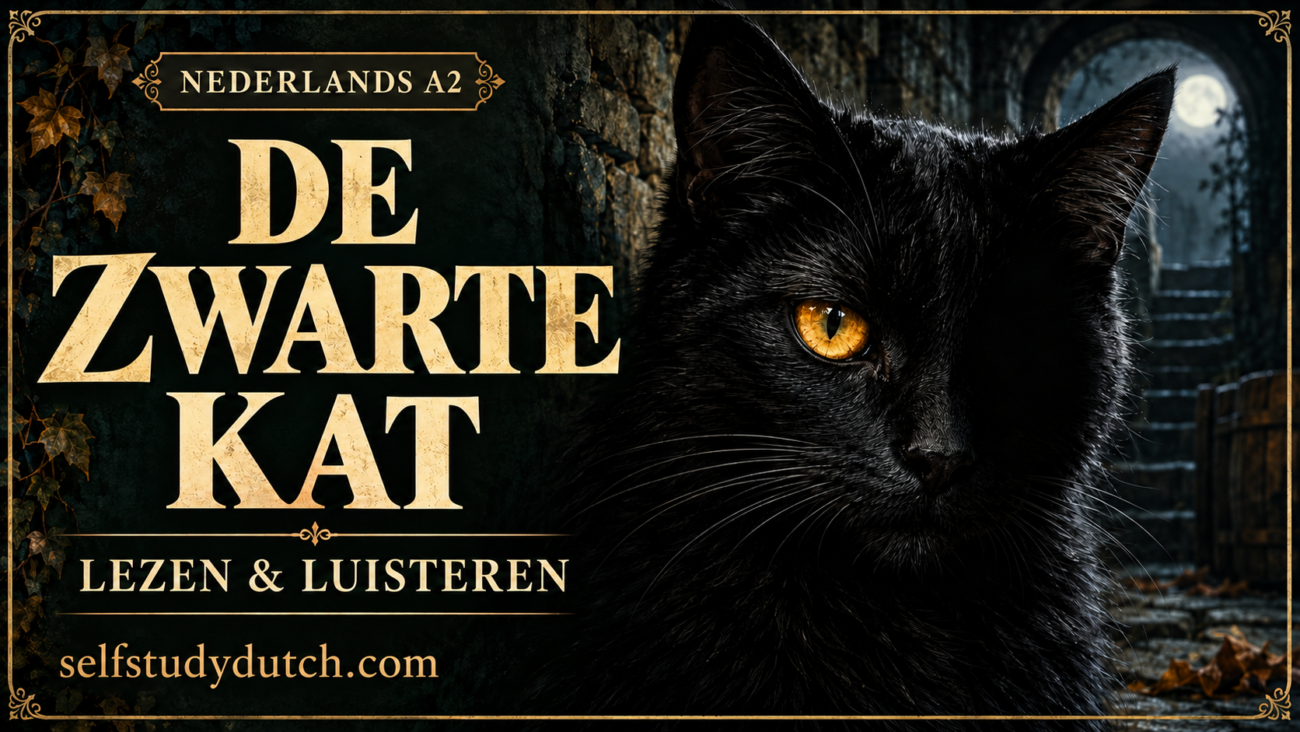
A black cat. A strange white patch. A sound behind a wall.
Practise your Dutch with De zwarte kat, an adaptation of Edgar Allan Poe’s The Black Cat. The video combines Dutch narration with text on screen, so you can read and listen at the same time.
The story uses short sentences and simplified language aimed at approximately A2 level. A few less common words help tell the mystery—you can find their meanings below.
Content note: This fictional story includes animal cruelty and murder, described without graphic detail. It is intended for adult learners.
Watch and read along
You do not need to understand every word. On your first listen, try to follow the main events: who is speaking, what happens and why the narrator becomes afraid.
How to practise with this story
Use the video in three short steps. You can spread them over several study sessions.
- Listen and read. Follow the Dutch text on screen. Keep going even if you meet an unfamiliar word.
- Check useful vocabulary. Read the word list below, then replay any passages you found difficult.
- Listen without reading. Look away from the screen and see how much you understand.
For speaking practice, choose two or three sentences. Pause the video after each sentence and repeat it aloud, copying the pronunciation and rhythm.
Useful Dutch vocabulary
| Dutch | English |
|---|---|
| de gevangenis | prison |
| dronken | drunk |
| bijten — hij beet | to bite — he bit |
| zich schamen — ik schaamde me | to feel ashamed — I felt ashamed |
| het touw | rope |
| de muur | wall |
| de vlek | patch; mark |
| de borst | chest |
| de schoot | lap |
| de galg | gallows |
| de kelder | cellar; basement |
| de bijl | axe |
| de agent | police officer |
| de kreet | cry; scream |
Notice that Dutch nouns are listed with de or het. Try learning the article together with the word: de muur, de vlek, het touw.
Useful phrases from the story
These expressions are useful beyond this particular story.
“Er was niets aan de hand.”
Meaning: Nothing was wrong.
In the story, the narrator becomes angry even when nothing is wrong:
Ik werd snel boos, ook als er niets aan de hand was.
“Hij liep overal achter me aan.”
Meaning: He followed me everywhere.
De kat liep achter me aan describes the cat walking after the narrator.
“Ik viel bijna.”
Meaning: I almost fell.
The word bijna means almost. You can also say:
- Ik ben bijna thuis. — I am almost home.
- Het is bijna twaalf uur. — It is almost twelve o’clock.
“Ik was te zeker van mezelf.”
Meaning: I was too sure of myself.
Here, te means too: the narrator’s confidence becomes a problem.
Notice the past tense
Most of the story describes events in the past. You will hear common past-tense forms repeatedly:
| Present | Past | Meaning |
|---|---|---|
| ik ben | ik was | I am → I was |
| ik heb | ik had | I have → I had |
| ik ga | ik ging | I go → I went |
| ik zie | ik zag | I see → I saw |
| ik hoor | ik hoorde | I hear → I heard |
| ik loop | ik liep | I walk → I walked |
At the beginning and end, the narrator speaks about his situation now:
Nu zit ik hier in de gevangenis.
Between those moments, he tells us what happened earlier. Listen for the change between his present situation and his memories.
Check your understanding
Answer these questions after watching. Short answers in Dutch are enough.
- Hoe heet de eerste kat?
- Wat gebeurt er ’s nachts met het huis?
- Wat heeft de tweede kat op zijn borst?
- Waarom valt de verteller bijna op de trap?
- Wat doet de verteller vlak voordat de agenten het geluid horen?
- Waar vinden de agenten de tweede kat?
Answers — check after trying
- De eerste kat heet Pluto.
- Het huis staat in brand.
- Hij heeft een witte vlek op zijn borst.
- De kat loopt tussen zijn voeten.
- Hij slaat met een stok tegen de muur.
- Achter de muur, boven op het hoofd van zijn vrouw.
What do you think happened?
The narrator sees the shape of a gallows in the cat’s white patch. But can we trust everything he tells us?
Try expressing your opinion in simple Dutch:
- Ik denk dat de verteller bang is.
- Volgens mij voelt hij zich schuldig.
- Ik weet niet of de kat bijzonder is.
There is no single required answer to this question. The aim is to practise explaining what you think.
More stories in simple Dutch
Would you like more reading and listening practice like this? Subscribe to the SelfStudyDutch YouTube channel for future stories in simple Dutch.
Leave a comment below: Was het verhaal makkelijk of moeilijk? En was het tempo goed?
De zwarte kat is a shortened adaptation in simple Dutch, based on The Black Cat by Edgar Allan Poe. A2 is the intended learning level, rather than an official assessment. The video narration was generated with ElevenLabs.
